


Olive oil production in the past: the memories of Grandfather Giuseppe

In this article, we will share a unique testimony about the olive oil production process and the way ancient olive mills operated.
This account was provided by our esteemed Grandfather Giuseppe, who personally lived through this experience. Thanks to his vivid memory and his great passion for tradition, we are taken back in time to an era when olive oil extraction was considered an art that required skill, hard work and patience.
We are certain that this testimony will be of great interest and value to all those who are passionate about history and ancient Italian traditions.
The olive oil production process in ancient mills, as described by Grandfather Giuseppe, was long and laborious work.

First, the harvested olives were transported to the olive mill, known locally as “u trappitu”, inside hemp sacks. The olives were then poured into the basin of the granite millstone and crushed.
This process produced the olive paste, which was collected and placed inside the “fiscole”, also known as “coffe”: circular mats made of vegetable fibres, used for the next stage of processing.
The fiscole, filled with crushed olive paste, were stacked one on top of the other and placed inside a press. The pressure generated by the press compressed and squeezed the paste, producing a liquid made up of vegetation water and oil.
This liquid was then left to rest in vats for several hours, allowing the natural separation of the vegetation water from the oil.
Since oil is lighter, it would rise to the surface and was collected with a jug before being poured into an iron container.
Afterwards, the oil was transferred into another container to remove the impurities that had settled at the bottom of the first one. At this point, the oil was ready to be consumed or sold.
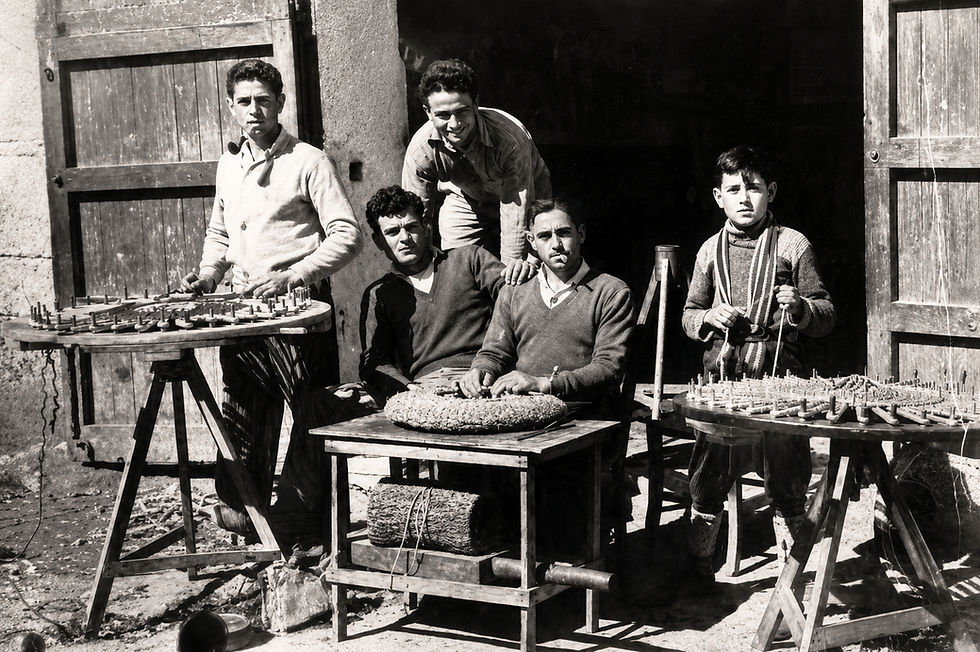
Artisanal production of the coffe – around 1965, Giunta olive mill.
The process began with the “raggiatura”, the manual weaving of coconut fibres which, according to family memories, arrived from India all the way to the railway station of Avola.
Once the weaving was completed, the coffa was “turned” and shaped into its typical circular and concave form, suitable for holding the olive paste during pressing.

Comments